Unleaded avgas fixes lead, not CO₂: what each new fuel changes for your plane
Unleaded avgas barely moves your CO₂ per hour. By Diamond's figures, a Jet-A diesel DA40 cuts it by about 15% to 27%. What each new fuel changes, with a checklist for owners, renters, schools and clubs.

6 min read
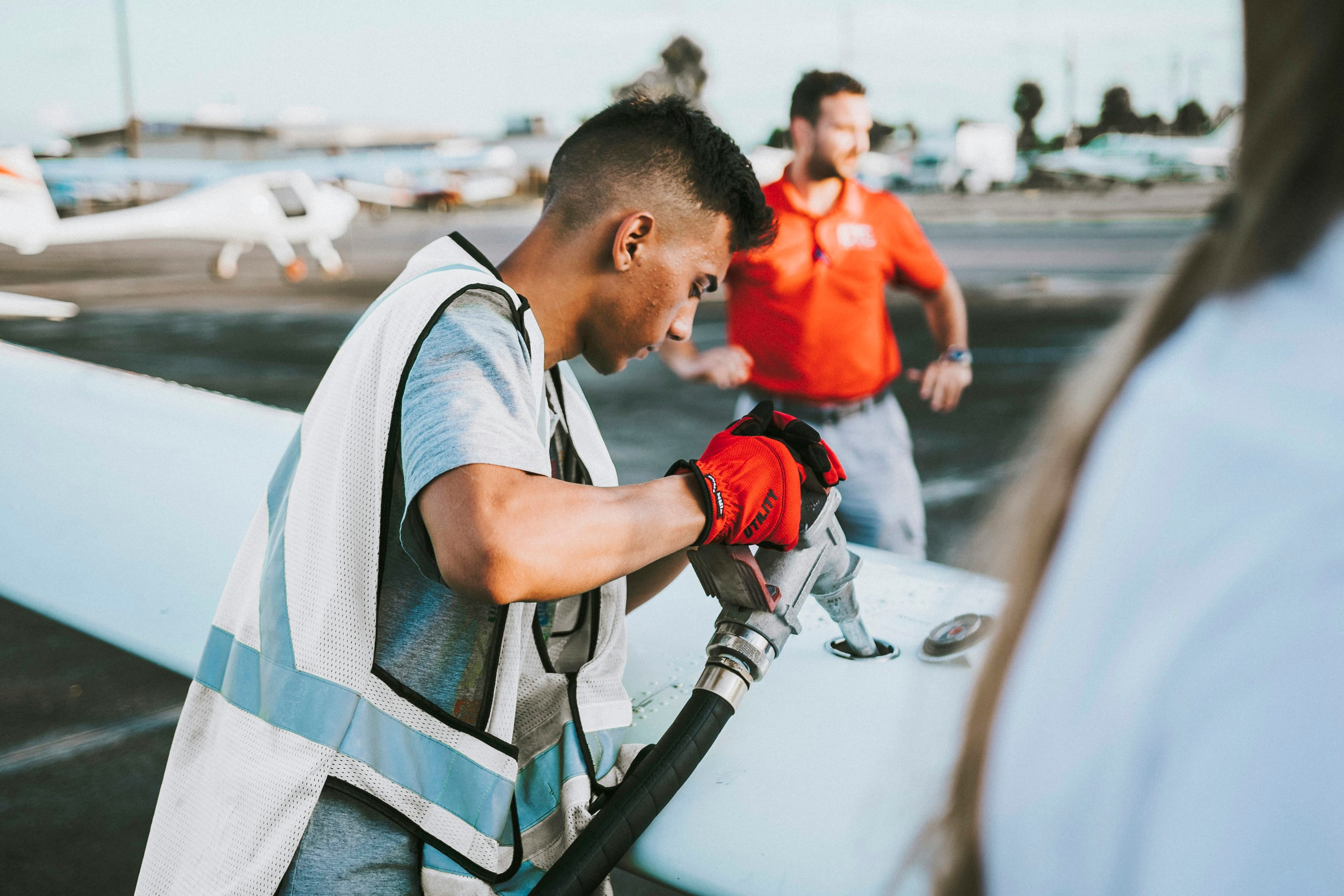
Every preflight, you drain fuel into a sampler and hold it up to the light. For decades it has been blue: 100LL. Under the FAA's current dye table, unleaded grades show up red (UL91), purple (UL94), green (100R), orange (UL100, also called UL100E) or yellow-green to blue-green (G100UL). The color in the tube is starting to change. The CO₂ from your exhaust will barely move.
The short answer: unleaded avgas doesn't reduce CO₂. The new grades are still petroleum fuels, and your engine needs about the same energy for the same power, so CO₂ per hour stays close to 100LL's: about 88 kg an hour in a 172 at typical cruise fuel flow (about 75% power).
I'm Jp Valery, a private pilot with night and float ratings and 170 hours, mostly in Cessna 172s and all on 100LL. Every one of those hours would have emitted about the same CO₂ on unleaded. I've offset all of them, which did nothing for the lead. Here is how I live with that. TrimCarbon sells carbon offsets.
Why unleaded avgas doesn't cut CO₂
Lead is an additive. Tetraethyl lead has been added to avgas since 1921 to boost octane. Take it out and the hydrocarbons, which hold the carbon, stay. Lead is a local problem: in 2023 the EPA found that lead emissions from certain aircraft engines cause or contribute to air pollution that may endanger public health. CO₂ does the same harm wherever it's emitted.
CO₂ follows energy. Per million BTU, EPA factors put avgas at 69.25 kg of CO₂, car gasoline at 70.22 and jet fuel at 72.22: within about 4%. Swap one petroleum fuel for another in the same engine and CO₂ per hour barely moves.
Lead is not CO₂. A full switch to unleaded would leave nearly all of the roughly 1.6 million tonnes of CO₂ that US avgas produced in 2025 (EIA; more in general aviation's carbon footprint). A carbon credit does nothing for the air around your airport, and switching to unleaded leaves your calculator number where it was. To cut CO₂, burn less fuel: start with the habits that cut fuel burn.
Fuel by fuel: what G100UL, 100R, UL94, diesel and SAF change
100LL. Lead: yes. CO₂: 8.31 kg per US gallon (EPA), the baseline.
UL91, UL94 and ethanol-free car gasoline (mogas). Lead: none. CO₂ per hour: essentially unchanged. In AOPA's 2016 UL94 test flight, "fuel flow and aircraft performance were unchanged". These lower-octane fuels are only for engines and airframes approved for them.
G100UL, 100R and UL100. Lead: none. CO₂: no producer publishes a factor. Expect about the same per hour as 100LL, possibly a few percent more. In AOPA's demo Baron, with G100UL in one engine and 100LL in the other, G100UL weighed 6.3 lb a gallon against 6.0 for avgas and its engine burned about half a gallon an hour less at the same power settings. GAMI's George Braly credits the fuel's higher energy density. More energy per gallon means more carbon per gallon: gallons saved aren't CO₂ saved.
Jet-A diesel (DA40 NG, DA42, DA62). Lead: none. CO₂: a US gallon of Jet A emits 9.75 kg of CO₂, 17% more than a gallon of avgas. So a diesel must burn at least about 15% fewer gallons to come out ahead. By Diamond's own figures, it does:
- DA40 NG (Jet A, 168 hp): 5.1 US gallons an hour at 60% power (about 101 hp), so about 50 kg of CO₂.
- DA40 XLT (avgas, 180 hp): 8.2 gallons an hour at 65% power (about 117 hp), so about 68 kg.
Our estimate: the NG emits about 15% (matched for horsepower) to 27% (at the published settings) less CO₂ an hour. The calculator's DA40 page is the avgas version: NG pilots should work from their fuel records (Jet A gallons × 9.75).
SAF (sustainable aviation fuel). It is blended into Jet A, not avgas, so it does nothing for an avgas engine. IATA says SAF cuts lifecycle CO₂ "typically by around 80%". EASA says that cut comes mostly from production: the exhaust still emits CO₂. At 80%, a 10% blend saves about 8%. Diesel pistons burn Jet A, but Austro Engine's 2024 brochure lists SAF capability as "under development".
We found no fully renewable avgas on sale in September 2026 (Swift's 100R is "10% renewable"). A SAF certificate (book and claim, in IATA's terms) pays for SAF burned in someone else's aircraft, so it works more like an offset than a change to your engine.
Electric. No lead, and no CO₂ in flight. Pipistrel calls its Velis Electro the first type-certified electric aircraft (EASA certified it), but about 50 minutes of typical endurance keeps it in the circuit (traffic pattern): see whether you can train on an electric plane yet (checked September 2026).
Switching to unleaded: status and checklist
Checked September 2026. The FAA's Transition Plan to Unleaded Aviation Gasoline (Version 1.0, released 30 July 2026) concludes that "a drop-in replacement for 100LL is not feasible", so every aircraft will need paperwork. Canada, where I trained, has set no formal deadline yet: ask Transport Canada or your aircraft maintenance engineer (AME) before relying on an FAA approval. For live status, follow the FAA, AOPA and EAGLE, the FAA-industry unleaded initiative.
- Check eligibility. Look up both the engine and the airframe on the STC pages from GAMI and Swift. Renters and club members: ask the operator.
- Book your mechanic. In the US, an authorized mechanic or repair station does the alteration: at least new fuel placards, a POH supplement and a logbook entry. Some also need modifications and a Form 337. Ask what to watch for: the FAA plan lists in-service reports under investigation.
- Ask your FBO. Find out what it will stock, at what price and from when.
- Keep logging fuel against Hobbs time. EPA's 8.31 kg a gallon is the avgas factor; for the new unleaded grades, treat it as an estimate until producers publish their own.
Fleet decisions for schools and clubs
Unleaded is a lead decision. It means less lead in the air your students, staff and neighbors breathe, and you can say so. Calling it a climate step or a "greener fuel" invites the CO₂ question, and from 27 September 2026 it will fall under EU rules on environmental claims (Directive 2024/825, applied through each country's law).
Diesel trainers do change CO₂. By Diamond's figures, a DA40 NG emits about 9 to 18 kg less an hour than a DA40 XLT: 5 to 11 tonnes a year at an assumed 600 hours.
Two fuels at one field means misfueling risk. The FAA notes there is "no grade selectivity among AvGas nozzle spouts or filler ports". Brief the new dye colors and placard 100LL-only aircraft. G100UL can look blue-green, so "not blue" isn't a reliable check. For fleet numbers, see a practical sustainability plan for schools and clubs.
Questions pilots ask
Can I mix unleaded avgas with 100LL? Only in an aircraft approved for that unleaded fuel; anything else is misfueling. In approved aircraft, producers say UL94, 100R and G100UL can each be mixed with 100LL in any proportion, and the FAA says UL100 is targeting the same approval. Don't mix unleaded fuels with each other: the FAA says no maker supports it.
Can my Cessna 172 use SAF or "sustainable avgas"? Not if it burns avgas. SAF is blended into Jet A, and we found no fully renewable avgas on sale in September 2026.
When will 100LL be banned? As of September 2026, there is no federal US ban. Congress has directed the FAA to work toward unleaded avgas by the end of 2030 (2032 in Alaska), a date the FAA's deputy administrator has said may slip. California bans leaded fuel sales from 1 January 2031. In the EU, Shell's authorization to blend the lead additive into avgas has a review period ending 30 April 2032: a review date, not a ban date.
What TrimCarbon covers
TrimCarbon deals with CO₂ only, and the calculator's figures hold on any avgas. Offsetting doesn't undo a flight: it funds an equal amount of CO₂ avoided or removed elsewhere, after you've cut what you can.
Our credits come through CNaught's Impact portfolio, from projects highly rated by at least one of Sylvera, BeZero, Calyx Global or Renoster, and are retired on public registries. Every order comes with your TrimCarbon certificate, listing the projects behind it (how to check one). Offsetting a 172 hour costs about $3.17 on the monthly plan, which bills at least 140 kg (about $5) a month. A one-time tonne is $40. See what an hour of flying costs to offset, pricing, and our pages for flight schools and clubs.
What does your flying emit?
Pick your aircraft and hours to see the CO₂ and what it costs to offset.
Calculate my hours