Flying vs driving: the CO₂ of a small plane, a car and an airline seat
Per-seat CO₂ for six piston types, from a Cessna 152 to a Bonanza, next to a car, an SUV and an airline seat, with two worked trips and the method.

6 min read
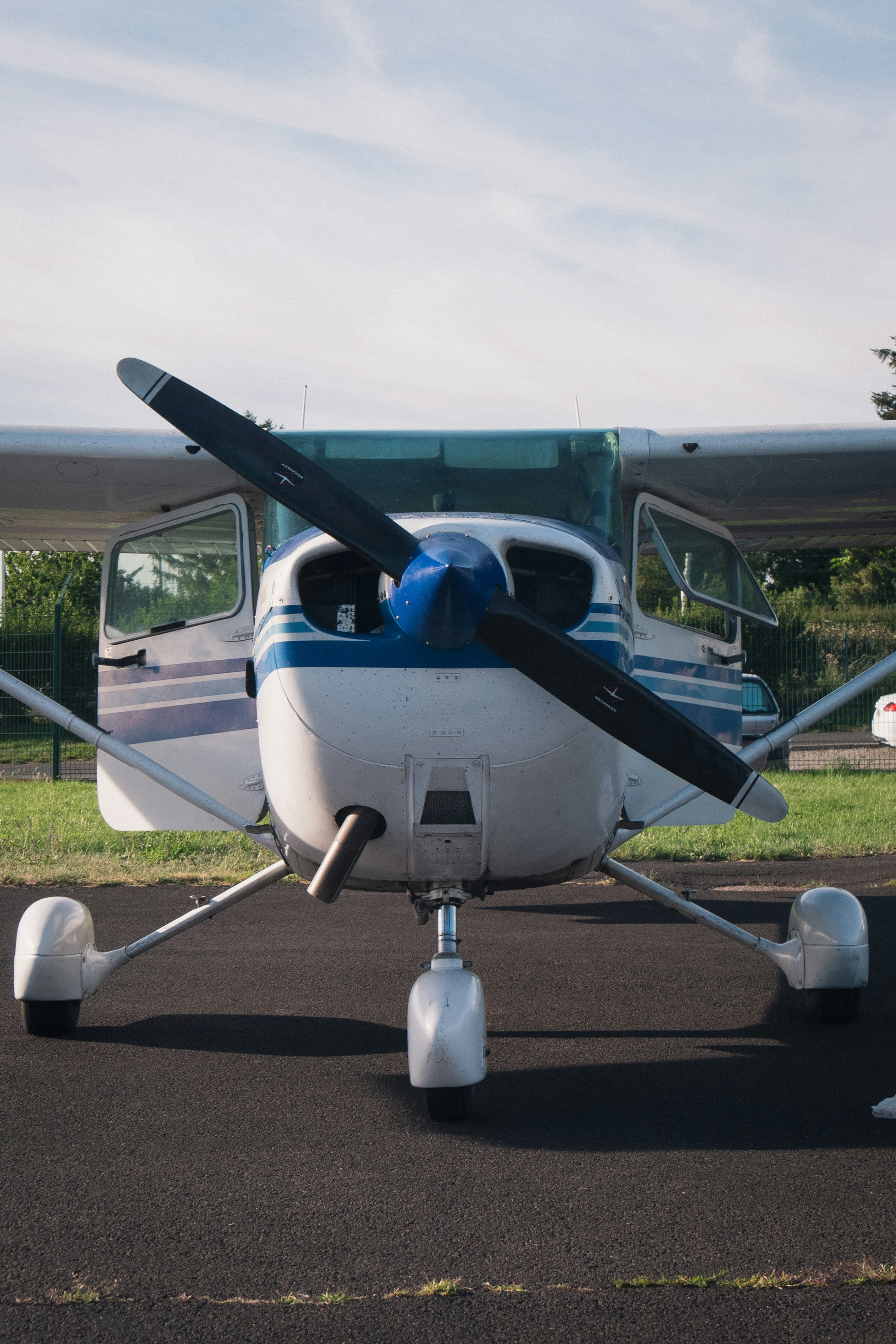
It depends on what you fly. Counting CO₂ only (EPA 2025), an airline seat beats driving alone, and two people sharing a car beat a short flight. A small plane is different: same trip, same people, a Cessna 172 emits about twice an average car's CO₂ (383 vs 185 g per km). Per seat, a 172 with four aboard roughly equals two people in a car.
I'm a private pilot with night and float ratings and 170 hours, mostly in Cessna 172s. TrimCarbon sells carbon offsets, and I run it. So I had two reasons to want this comparison to flatter small planes. Mostly, it doesn't: on a 135 nautical mile trip, a 172 emits about 122 kg of CO₂, and an average car about 55 kg.
Is it better to fly or drive? The airline answer
Most flying vs driving articles compare a car with an airline seat. Here is the CO₂ column of the US government's GHG Emission Factors Hub (EPA 2025, Table 10), per km for a whole car and per passenger-km (one person, one km) for the rest:
- Average passenger car: 185 g (297 g per mile)
- SUV, pickup or minivan: 245 g (394 g per mile)
- Airline seat, flights under 300 miles: 129 g
- Airline seat, 300 to 2,300 miles: 80 g
- Amtrak, national average: 60 g
- Bus: 41 g
Split the car's figure between the people inside. Driving solo, the airline seat wins. Two in the car (92 g each) beat a short flight and come close to a longer one. With three or more, the car wins.
Jets at cruise altitude also warm the climate through contrails and other non-CO₂ effects. The UK government's 2026 conversion factors multiply a domestic flight's CO₂ by about 1.7 to include them, which puts a short flight above driving alone.
Is flying a small plane worse than driving?
Compare the vehicles, not the seats. Extra passengers barely change a car's CO₂ or a 172's, so compare plane with car for the same people and trip.
Our calculator puts a Cessna 172 at 10.6 US gallons and 88 kg of CO₂ an hour at typical cruise (about 75% power). At Textron's max cruise speed of 124 knots (230 km/h), a Cessna 172 emits about 383 g of CO₂ per km flown, whoever is aboard. That's 2.1 times an average passenger car (185 g) and 1.6 times an SUV. Plane & Pilot's 2009 172S figures (126 knots on 9.7 gallons an hour) give 1.9 times the car, so "about twice" holds either way.
Trip 1: visiting family. Say they live 135 nm (250 km) away direct, 300 km (186 miles) by road. At 124 knots with no wind, the flight takes about 65 minutes. Add 0.3 hours for start, taxi, run-up, climb and arrival, and the Hobbs meter shows about 1.4 hours.
- Cessna 172: 1.39 h × 88 kg = 122 kg
- Average car: 300 km × 185 g = 55 kg
- SUV or pickup: 300 km × 245 g = 73 kg
For the same people, the car emits about half. With preflight and the airport drives, the plane saves less time than the Hobbs suggests.
Small plane CO₂ per passenger: six types compared
Per-seat figures matter when each person would otherwise travel alone. How to calculate flight emissions explains the per-hour figures; a well-leaned or training hour burns less, and your fuel receipts settle it.
Grams of CO₂ per passenger-km, one to four aboard:
- Cessna 150/152 (58 kg/h; 107 knots): 293 / 146 (two seats)
- Piper PA-28 (77 kg/h; 116 knots on 9.0 gallons): 358 / 179 / 119 / 90
- Cessna 172 (88 kg/h; 124 knots): 383 / 192 / 128 / 96
- Mooney M20 (83 kg/h; 155 knots): 289 / 145 / 96 / 72
- Cirrus SR22 (100 kg/h; 160 knots): 337 / 169 / 112 / 84
- Beechcraft Bonanza (125 kg/h; 168 knots): 402 / 201 / 134 / 100
Against EPA's figures, two aboard a light single is about one person driving alone (185 g). Four aboard is about two sharing a car (92 g each). Don't read close numbers as a ranking: a solo Mooney and a solo 152 are level, and SR22 fuel flow depends heavily on leaning.
Four aboard is a best case for short legs. Textron lists a full-fuel payload of 560 lb for a new 172S, so four adults usually means partial tanks. At 170 lb each and no bags, about 33 gallons fit, enough for trip 1. At 190 lb each, about 19.7 gallons fit, just short of the 20 that trip 1 needs with the 30-minute day VFR reserve (14 CFR 91.151 and Canada's CAR 602.88). The 45-minute night reserve leaves it further short. Do your own aircraft's weight and balance.
Per hour isn't per mile: faster planes on the same trip
Trip 2: a longer run. It's 360 nm (667 km) direct and 800 km (about 500 miles) by road, beyond a 152's 350 nm range with reserve on standard tanks. Hobbs time is 360 nm ÷ cruise speed, plus 0.3 hours:
- Cessna 172: 3.20 h, 282 kg
- Piper PA-28: 3.40 h, 262 kg
- Mooney M20: 2.62 h, 218 kg
- Beechcraft Bonanza: 2.44 h, 305 kg
- Cirrus SR22: 2.55 h, 255 kg
Per hour, a Bonanza emits 42% more CO₂ than a Cessna 172. On this 360 nm trip it emits only 8% more, because it lands about 45 minutes sooner. A Mooney M20 emits 6% less per hour and 23% less per trip. If your 172 burns 9.7 gallons an hour, the gaps become 18% and 16%. No plane here matches the car: an average car emits 148 kg on this trip and an SUV 196 kg, so even the Mooney emits about 1.5 times the car.
To compare aircraft for trips, divide kg per hour by cruise speed. Within one aircraft, a lower power setting usually saves fuel per mile too: about 8% per nm for an Archer II at 65% power instead of 75%, on Plane & Pilot's numbers.
Fill the seats: club fly-outs and ground school
Take a club fly-out: nine members in three 172s, three aboard each, 100 nm each way. At about 1.1 Hobbs hours and 97 kg per plane each way, the day comes to 584 kg, or 65 kg per member. Three cars carrying the same nine would emit 246 kg, or 27 kg per member. A fly-out is flying for its own sake, and that's fine.
Full seats are what count: flown solo, the nine would emit about 1,750 kg, three times as much. They also split the rental, within cost-sharing rules. A ride-share sheet helps, and three 190 lb adults still leave room for about 51 gallons in a new 172S.
A training cross-country doesn't replace a drive, so its CO₂ belongs to the carbon footprint of learning to fly. The comparison still makes a good ground-school exercise: students work out the CO₂ of their planned cross-country and of driving the same route, from their fuel planning. For fleet totals, here's how TrimCarbon works for flying clubs and flight schools.
How we worked it out
- Aircraft: our calculator's CO₂ per hour (typical cruise fuel flow, about 75% power, × 8.31 kg per US gallon of avgas, the EPA factor) ÷ each type's sourced cruise speed in km/h (knots × 1.852) ÷ people aboard.
- Assumptions: 0.3 hours per leg for ground time and climb; roads 20% longer than direct; no wind.
- Other modes: EPA 2025, Table 10, combustion CO₂ only. The airline factors include typical seat occupancy.
- Left out: producing the fuel, the drive to the airport, detours around airspace, non-CO₂ effects at altitude, and lead (a health issue, not a climate one).
Questions pilots ask
Should I fly or drive? For the same people, a car emits about half what a 172 does. If you fly, fill the seats, fly a lower power setting and offset what's left. I write about that trade-off in flying with a climate conscience.
How many cars equal one small plane? In cruise, a Cessna 172 emits per km about what two average passenger cars do (EPA 2025). A Bonanza equals about 2.2 cars, a Mooney M20 about 1.6.
How many miles per gallon does a Cessna 172 get? About 13.5 statute miles per US gallon (11.7 nm) at 10.6 gallons an hour and 124 knots. EPA's average US gasoline vehicle gets 22.2 mpg, and the passenger-car factor used here works out to about 30 mpg.
Is a private plane worse than a commercial flight per passenger? With four aboard, a 172 is about 96 g per passenger-km, below a short-flight airline seat (129 g). Flown solo, it's about three times the seat. Private jets are another story: see general aviation's carbon footprint.
Counting your own trips with TrimCarbon
Find your aircraft in the calculator and multiply its kg per hour by your Hobbs time (tach time undercounts). At the monthly plan's $0.036 per kg, trip 1's 122 kg is worth about $4.40, though the plan bills at least 140 kg (about $5) a month, and a $40 one-time tonne covers about eight such trips. What an hour costs to offset has the details.
Our credits come through CNaught's Impact portfolio, from projects that CNaught says are highly rated by at least one of Sylvera, BeZero, Calyx Global or Renoster. Every order comes with your TrimCarbon certificate. Offsetting doesn't cancel the trip's CO₂: it funds the same amount in rated carbon credits, retired on public registries. The steps are in how to offset your flying.
What does your flying emit?
Pick your aircraft and hours to see the CO₂ and what it costs to offset.
Calculate my hours