Do small planes make contrails? Why a 172 is (mostly) a CO₂ story
A Cessna 172's ceiling sits about 12,900 feet below the lowest altitude where jet exhaust makes contrails on a standard day. What that means for the 1.7× and 3× multipliers some calculators add, and for what you offset.

6 min read
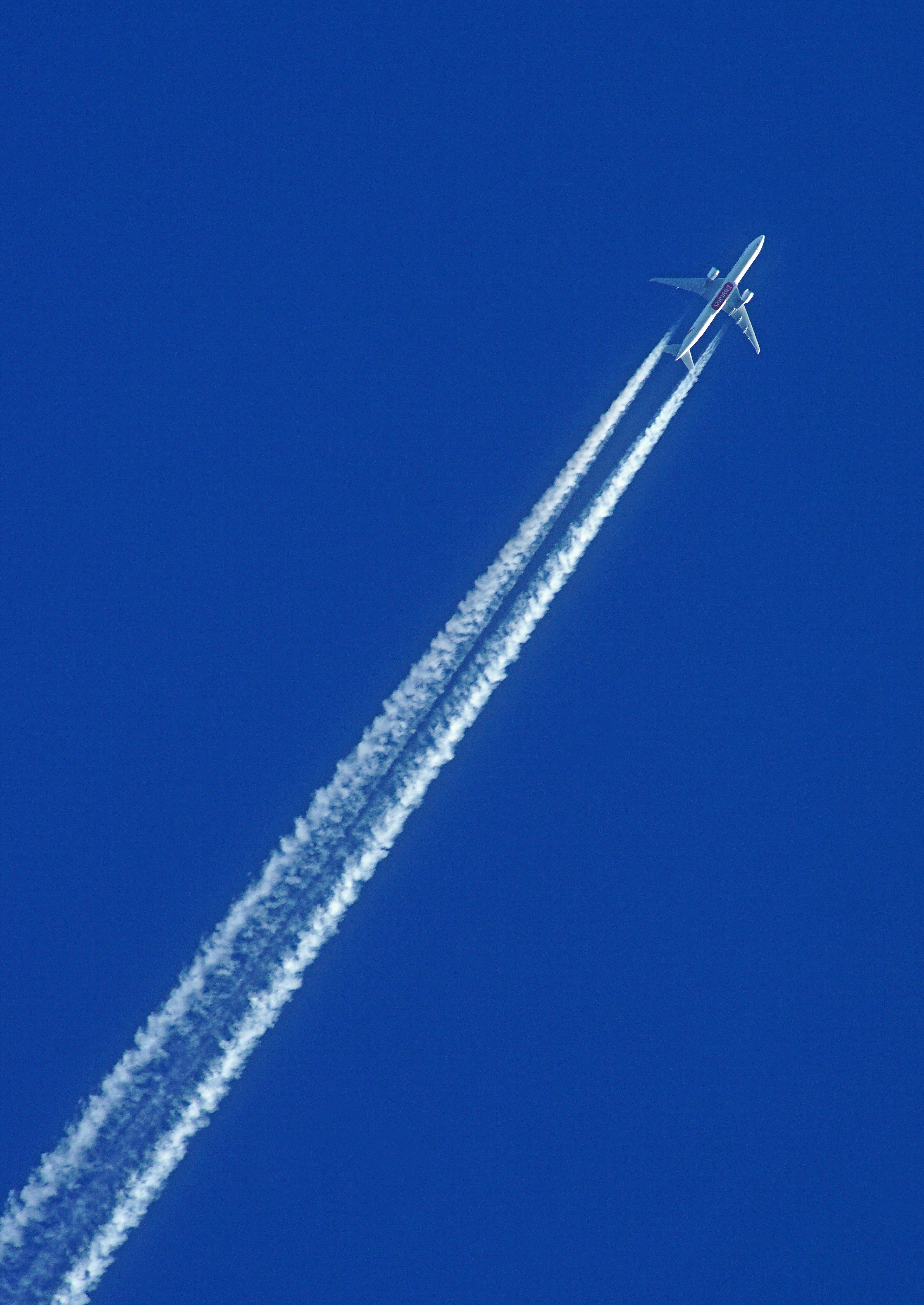
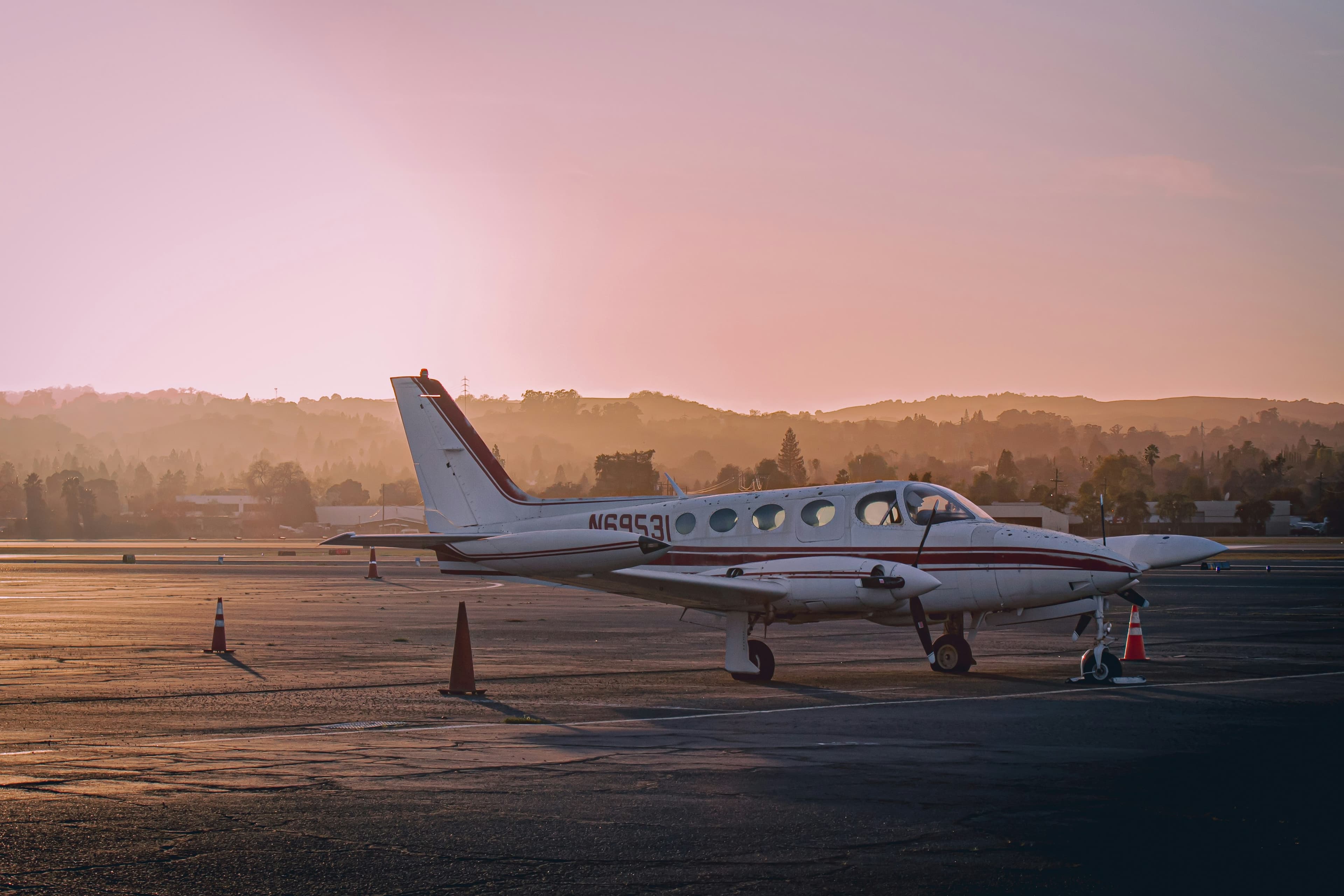
Rarely. Contrails need very cold air. On a standard day, the lowest altitude where jet exhaust makes one is about 27,000 feet, and even there only in saturated air. A Cessna 172 tops out at 14,000 feet. The exception is deep cold: in mid-winter in central Canada, contrails can form at ground level. For most piston flying, the part anyone can measure is CO₂.
Nearly every white line in the sky is drawn by a jet at cruise altitude, in air colder than −40 °C. So why do some calculators multiply flight CO₂ by 1.7 or 3, and should you do it for your 172? A note on our interest: TrimCarbon sells carbon offsets by the kg, so a bigger multiplier would mean a bigger sale.
How a contrail forms
It's your breath on a cold morning. Burning the hydrogen in fuel makes water, 100LL included, so every engine's exhaust is hot and moist. As it mixes with cold outside air, its humidity climbs. If the air is cold enough, droplets form on soot and other particles, and many freeze. The threshold also depends on pressure, the fuel and the engine: more efficient engines make contrails in warmer air.
In dry air, a contrail often vanishes within seconds to minutes. In ice-supersaturated air, it persists and can spread into cirrus, the kind that matters for the climate.
Contrails form behind propeller aircraft too, and were first seen in 1915.
Why small planes rarely make contrails
On a standard day, the air at a 172's 14,000-foot ceiling is about −13 °C. Ulrich Schumann's 2005 review puts the lowest standard-day contrail altitude at about 26,900 feet (8.2 km, about −38 °C), and only in saturated air, which is rare that cold. That's 12,900 feet above a 172's ceiling. In completely dry air, contrails form only between about 33,500 and 46,000 feet. Both figures assume jet fuel and an early-1990s airliner engine.
Real weather moves the line. In temperate and polar latitudes, long-lasting contrails can form down to about 16,400 feet (5 km), just 2,400 feet above a 172's ceiling. Few 172s spend long near the ceiling, though: US rules require crew oxygen after 30 minutes above 12,500 feet.
The rare exception: deep cold
In mid-winter in Alaska, Siberia and central Canada, aircraft exhaust can make ice fog at ground level, and airfields there have sometimes had to close when it persisted. One pilot on a forum recalls "contrails taking off in a C-207 up in Alaska."
Do turboprops leave contrails?
They can, near their ceilings. A TBM 960 is certified to 31,000 feet and the PC-12 has a 30,000-foot limit, both above the standard-day floor. Turbocharged pistons get closer too: an SR22T can operate up to 25,000 feet, well above that 16,400-foot line. The UK government expects non-CO₂ effects to be "less pronounced for turboprops" than for airliners, but says the evidence "does not provide a mechanism to treat them differently".
The wisps off your wingtips are something else
In nearly saturated air, white wisps can curl off the wingtips or prop tips. These "aerodynamic trails" form when the pressure drop around a prop or wingtip cools the air until it condenses, not from the exhaust. Schumann calls wingtip trails rare and "of little practical importance".
Are contrails bad for the climate?
The persistent ones are. Contrail cirrus was aviation's largest single warming term in 2018. A 2021 study put aviation's share at 2.4% of annual CO₂ but about 4% of human-induced warming to date. In 2019, about 2% of flights caused 80% of that year's contrail warming, a 2024 study of global flights found. Jets dominate those figures. For GA's share, see how big general aviation's footprint really is.
Where the 1.7× and 3× multipliers come from
Non-CO₂ multiplier (uplift): a number some calculators apply to flight CO₂ for the warming from contrails, nitrogen oxides and water vapor. It's an average for a mostly-jet fleet.
Radiative forcing index (RFI): aviation's total warming effect at one moment, divided by that of its CO₂ alone. It's one way to set the multiplier. The IPCC's 1999 range was 2 to 4.
The yardstick changes the number. For 2018, the UK government lists these multipliers (CO₂-equivalent ÷ CO₂) from Lee et al.:
- Over 20 years (GWP20): 4.0
- Over 100 years (GWP100): 1.7
- GWP*: 3.0
- Temperature-based (GTP): 1.0 to 1.3
About 1.7 is the UK government's 2026 central value, "subject to significant uncertainty". It's published for air travel, air freight and jet fuel, not for its avgas factor, and applied at every altitude because the evidence can't separate them.
3 is atmosfair's factor, applied only to CO₂ emitted above 9,000 m (about 29,500 feet). myclimate moved to 3 in 2023.
If a program sells you a multiplier (one GA program launched a 300% level in 2022), ask which method it uses and whether it applies at your altitudes.
Should you multiply your CO₂ by 1.7 or 3?
One hour in a 172, three answers. A 172 emits about 88 kg of CO₂ an hour at typical cruise fuel flow (about 75% power). Borrow airline methods and that hour becomes:
- atmosfair's altitude rule: 88 kg, since a 172 can't reach 9,000 m.
- The UK government's 1.7: about 150 kg.
- A flat 3×: 264 kg.
At $0.036 per kg (our monthly rate), that's $3.17 for the 88 kg, or $9.50 with a flat 3×. More on what an hour of flying costs to offset.
With no study to set a multiplier for piston flying, up or down, we count the CO₂ from burning your fuel, which your fuel receipts can check, and leave any extra to you.
Before any buffer, cut your fuel burn. Every US gallon you save is 8.31 kg of CO₂, plus less of everything else in the exhaust.
If you want a buffer anyway, choose its size and say so. Set your plan's hours a little above what you log, or add one-time tonnes at $40. Fly 100 Hobbs hours a year in a 172 (8,800 kg), add two one-time tonnes, and you can say: "I funded the retirement of 10.8 tonnes of rated carbon credits: 8.8 for my flight CO₂, plus 2 as a buffer for effects nobody has measured."
What nobody has measured yet
As of September 2026:
- Piston non-CO₂ warming. We found no published study that puts a number on it.
- How often pistons make contrails. No modern study we found checks this, even in very cold climates.
- Lead and clouds. A 2009 study found that lead-containing particles, partly from aviation fuel, are among the most efficient at forming ice, and may partly counter greenhouse warming. We found no estimate for pistons. More in what unleaded avgas changes.
Unmeasured is not the same as zero. When the science gives a number for piston aircraft, we'll update this page.
Contrails in ground school
Contrails make a ready-made meteorology lesson, built on the lapse rate and saturation students already learn for clouds and carb icing. Have them find the −38 °C level in the standard atmosphere and in today's winds and temperatures aloft forecast, then compare it with their training altitude.
When you report the fleet's footprint, describe it accurately: combustion CO₂, plus any buffer you added.
Questions pilots ask
Does 100LL make contrails like Jet A? Yes, by the same physics: any fuel's hydrogen makes water. Cold air decides, and a normally aspirated piston rarely climbs into enough of it.
Why does another calculator show a bigger number than TrimCarbon? Usually it adds a non-CO₂ multiplier or the emissions from producing the fuel, or it assumes a higher fuel flow than typical cruise. Check what each one counts.
Does offsetting cancel a contrail? No. An offset funds CO₂ avoided or removed elsewhere. It doesn't touch a contrail or cancel the flight. Here's what you can claim after offsetting.
What TrimCarbon counts, and why
- Counted: CO₂ from burning the fuel, at each type's typical cruise fuel flow, times your hours. See what our figures count.
- Not counted: producing and transporting the fuel, and non-CO₂ effects such as contrails.
- Plans: sized from your aircraft and hours. See plans and prices.
- Credits: drawn from CNaught's Impact portfolio of projects highly rated by at least one of Sylvera, BeZero, Calyx Global or Renoster, and retired on public registries. Your TrimCarbon certificate lists each project behind your order and its kg. See how to check what a certificate shows.
- Jets and turboprops: our figures are CO₂ only, and on average a jet flight warms more than its CO₂ alone. Turboprops aren't in the calculator, so ask us for a custom estimate.
What does your flying emit?
Pick your aircraft and hours to see the CO₂ and what it costs to offset.
Calculate my hours